
In today’s complex investment environment, operational precision is critical to performance, risk management, and regulatory compliance. Yet many financial institutions continue to face investment operations gaps – breakdowns in processes, data integrity, and system alignment that reduce efficiency and increase risk.
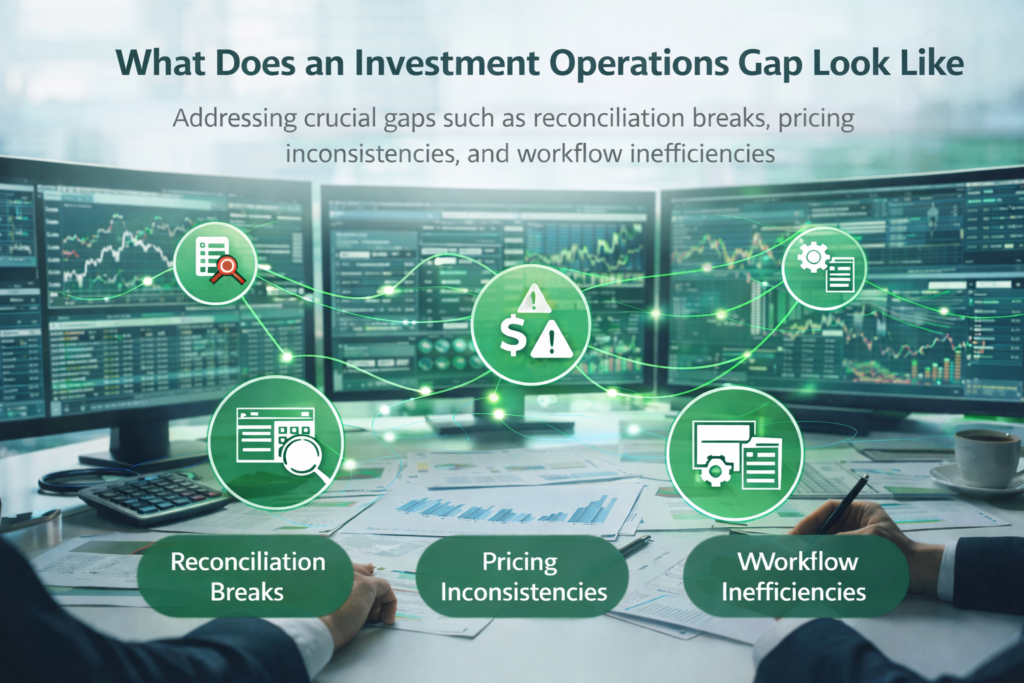
One of the most visible signs is persistent reconciliation breaks. These occur when positions, cash balances, or transactions do not match across systems or custodians. While occasional discrepancies are expected, recurring breaks often indicate deeper issues such as inconsistent data sources, timing mismatches, or incomplete integrations. Over time, these gaps increase manual workload and operational risk.
Pricing inconsistencies are another common challenge. Inaccurate or delayed pricing, often caused by gaps in market data feeds or system configurations, can directly impact portfolio valuation and reporting. For firms managing complex instruments, even small discrepancies can result in material differences, affecting both internal controls and external reporting.
Workflow inefficiencies further amplify these issues. Many organizations still rely on manual processes, email-driven approvals, and disconnected systems. As volumes grow, these workflows become difficult to scale, leading to delays, duplicated efforts, and limited transparency across teams.
At the core of these challenges is misalignment between technology, data, and operations. According to Deloitte (2023), fragmented operating models continue to hinder efficiency and control, particularly as reporting and regulatory demands increase.
Ievers helps firms identify and close these gaps by aligning systems, strengthening data integrity, and streamlining workflows. Through targeted improvements and practical execution, firms can move from reactive operations to a more controlled, scalable, and efficient model.
Message us for a quick gap assessment.