Author: jgarcia

  • The Hidden Risk Most Institutional Investors Overlook: Technology Misalignment

    The Hidden Risk Most Institutional Investors Overlook: Technology Misalignment

    In today’s institutional investment landscape, risk management frameworks have evolved significantly. Market volatility, liquidity constraints, and geopolitical uncertainty are routinely modeled, analyzed, and stress-tested. Yet despite these advancements, one critical risk continues to operate under the radar – technology misalignment.

    Beyond Traditional Risk: The Infrastructure Gap

    Institutional investors have historically focused on external variables: market performance, asset allocation, and macroeconomic shifts. However, the internal systems supporting these decisions are often overlooked.

    Technology misalignment occurs when investment strategy evolves faster than the infrastructure designed to support it. This disconnect can manifest in several ways:

    • Fragmented data systems across departments
    • Legacy platforms unable to process real-time insights
    • Manual workflows that delay critical decisions
    • Inconsistent reporting across portfolios

    Individually, these issues may seem operational. Collectively, they create strategic blind spots.

    The Cost of Misalignment

    The impact of outdated or disconnected systems goes far beyond inefficiency.Institutions may experience:

    • Delayed decision-making, reducing responsiveness to market changes
    • Reduced data accuracy, affecting confidence in insights
    • Operational bottlenecks, limiting scalability
    • Increased risk exposure, due to incomplete visibility

    In a market where timing, precision, and insight are critical, these challenges can directly influence performance outcomes.

    Why This Risk Is Often Overlooked

    Unlike market volatility or regulatory compliance, technology misalignment is not always immediately visible. It develops gradually, often as a byproduct of growth, system upgrades, or evolving investment strategies. Because of this, many organizations adapt around inefficiencies rather than addressing their root cause.

    Over time, this creates a gap between what the organization aims to achieve and what its systems are capable of supporting.

    Aligning Strategy with Technology

    Forward-thinking institutions are beginning to recognize that technology is no longer just a support function. It is a strategic enabler. Aligning infrastructure with investment strategy involves:

    • Integrating data systems for unified visibility
    • Modernizing platforms to support real-time analytics
    • Automating workflows to reduce delays and manual intervention
    • Designing scalable architectures that grow with the organization

    This alignment enables firms to operate with greater agility, accuracy, and confidence.

    A Shift in Perspective

    The future of institutional investing will not be defined solely by asset selection or market timing. It will be defined by how effectively organizations can:

    • Harness data
    • Streamline operations
    • Enable faster, more informed decisions

    In this context, technology is no longer a background function –  it becomes a core driver of competitive advantage.

    Final Thought

    The question is no longer whether technology plays a role in investment success, but whether your current systems are fully aligned with your strategic ambitions. Because in today’s environment, the greatest risk may not be what you see in the market, but what remains unseen within your own infrastructure.


  • The Hidden Cost of Manual Workflows

    The Hidden Cost of Manual Workflows

    Manual workflows remain embedded across many investment operations and reconciliation environments, often viewed as a cost of doing business. In reality, they represent a growing source of operational risk, inefficiency, and scalability constraints.

    Processes such as trade handling, cash reconciliation, and pricing validation, when executed manually, introduce a higher probability of human error. A 2024 report by PwC highlights that reliance on manual processes increases the likelihood of data inconsistencies and reporting inaccuracies, particularly in high-volume financial environments. These issues can lead to reconciliation breaks, delayed close cycles, and potential compliance exposure.

    Efficiency losses are equally significant. According to Capgemini (2023), organizations dependent on manual operations face slower processing times and limited visibility into workflows, reducing their ability to respond to time-sensitive market demands. In reconciliation functions, this often translates into prolonged issue resolution and increased operational overhead.

    Perhaps most critically, manual workflows hinder scalability. As firms grow and transaction volumes increase, these processes become bottlenecks. Gartner notes that organizations lacking automation struggle to scale efficiently, driving up costs while limiting agility.

    Manual operations are no longer sustainable in modern financial environments. Firms that modernize workflows gain not only efficiency, but control, accuracy, and long-term resilience.

    Let’s optimize your workflow.

  • What Does an Investment Operations Gap Look Like

    What Does an Investment Operations Gap Look Like

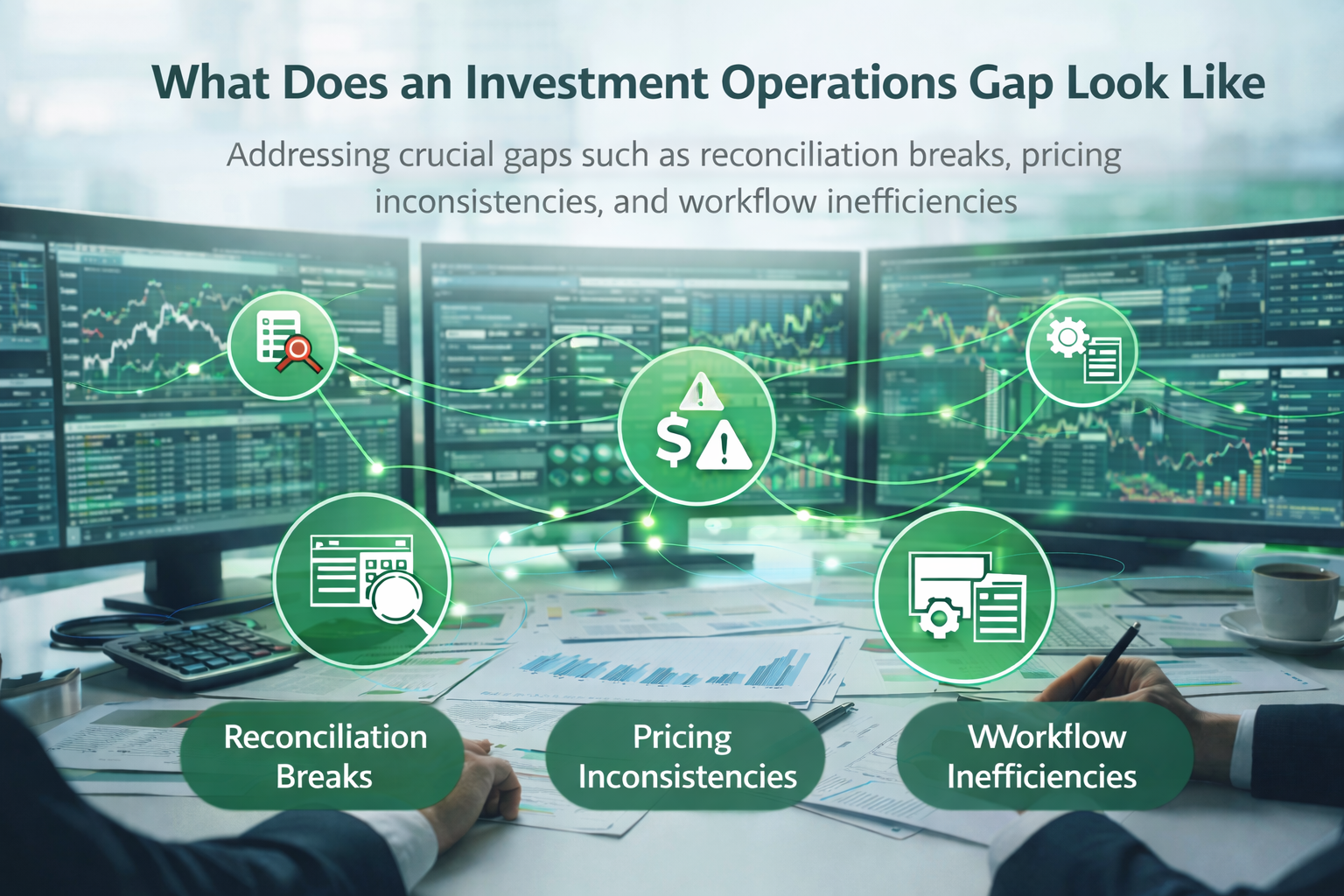
    In today’s complex investment environment, operational precision is critical to performance, risk management, and regulatory compliance. Yet many financial institutions continue to face investment operations gaps – breakdowns in processes, data integrity, and system alignment that reduce efficiency and increase risk.

    One of the most visible signs is persistent reconciliation breaks. These occur when positions, cash balances, or transactions do not match across systems or custodians. While occasional discrepancies are expected, recurring breaks often indicate deeper issues such as inconsistent data sources, timing mismatches, or incomplete integrations. Over time, these gaps increase manual workload and operational risk.

    Pricing inconsistencies are another common challenge. Inaccurate or delayed pricing, often caused by gaps in market data feeds or system configurations, can directly impact portfolio valuation and reporting. For firms managing complex instruments, even small discrepancies can result in material differences, affecting both internal controls and external reporting.

    Workflow inefficiencies further amplify these issues. Many organizations still rely on manual processes, email-driven approvals, and disconnected systems. As volumes grow, these workflows become difficult to scale, leading to delays, duplicated efforts, and limited transparency across teams.

    At the core of these challenges is misalignment between technology, data, and operations. According to Deloitte (2023), fragmented operating models continue to hinder efficiency and control, particularly as reporting and regulatory demands increase.

    Ievers helps firms identify and close these gaps by aligning systems, strengthening data integrity, and streamlining workflows. Through targeted improvements and practical execution, firms can move from reactive operations to a more controlled, scalable, and efficient model.

    Message us for a quick gap assessment.

  • Why Traditional Investment Ops Models Are Breaking

    Why Traditional Investment Ops Models Are Breaking

    The operating landscape for investment management firms has undergone a profound transformation, yet many institutions continue to rely on legacy operating models that were not designed for today’s level of complexity. As firms expand across asset classes, including equities, fixed income, derivatives, private markets, and alternative investments, the limitations of traditional investment operations frameworks are becoming increasingly evident.

    One of the most pressing challenges lies in the growing fragmentation of data and processes. Investment operations teams are now required to manage activities across a wide network of global custodians, counterparties, and systems. This has led to highly manual workflows, duplicated efforts, and inconsistent data reconciliation practices. According to Deloitte (2023), many firms continue to operate within siloed infrastructures that limit real-time data visibility and increase operational risk. Similarly, research from McKinsey & Company (2022) indicates that legacy systems struggle to support the scalability and flexibility required in increasingly complex investment environments.

    Operational inefficiencies are further compounded by evolving regulatory requirements and heightened expectations for transparency. Firms must now deliver more frequent and granular reporting while maintaining data accuracy across multiple platforms. Traditional operating models, largely dependent on batch processing and manual intervention, are not designed to meet these demands efficiently. Industry analyses from Deloitte and McKinsey & Company further emphasize that firms are experiencing rising operational costs as they attempt to retrofit outdated systems instead of modernizing their core infrastructure.

    Moreover, the lack of scalability inherent in traditional models constrains growth. As transaction volumes increase and new asset classes are introduced, existing workflows become operational bottlenecks. This not only impacts efficiency but also limits a firm’s ability to respond to market opportunities and client demands. In a highly competitive environment, these constraints can translate into material disadvantages.

    Forward-looking institutions are now re-evaluating their operating models, prioritizing automation, integrated data architectures, and scalable infrastructure. This shift reflects a broader recognition that operations must evolve from a cost center to a strategic enabler of growth, resilience, and innovation.

    The breakdown of traditional investment operations models is no longer theoretical. It is actively reshaping the industry. Firms that take a proactive approach to transformation will be better positioned to navigate increasing complexity and sustain long-term performance.

    How Ievers Helps Address These Challenges

    Ievers supports investment managers in transitioning from fragmented, legacy operating models to scalable, integrated, and future-ready frameworks. With deep expertise across platforms such as SS&C Geneva and complex multi-custodian environments, Ievers provides targeted solutions that address both structural inefficiencies and operational risk.

    At the core of Ievers’ approach is the alignment of data, workflows, and governance. By streamlining reconciliation processes, optimizing data architectures, and implementing controlled automation, Ievers enables firms to reduce manual intervention while improving accuracy and transparency. This is particularly critical in environments where data consistency across custodians and systems is essential for reporting, compliance, and decision-making.

    Ievers also brings a pragmatic, execution-focused model that combines domain expertise with flexible delivery. Rather than imposing rigid transformation programs, Ievers works alongside client teams to identify high-impact opportunities, implement scalable solutions, and ensure continuity of operations. This includes enhancing reporting frameworks, strengthening operational controls, and enabling more efficient use of existing technology investments.

    As firms continue to face increasing complexity and cost pressures, the ability to modernize operations without disrupting core processes becomes a key differentiator. Ievers positions itself as a strategic partner in this transformation – helping institutions build resilient, scalable, and efficient operating models that can support long-term growth.

    Let’s connect to discuss how firms are adapting.

  • The Role of Advent Geneva in Financial Institutions

    The Role of Advent Geneva in Financial Institutions

    A Foundation for Modern Investment Operations

    Advent Geneva is, at the core, the backbone for many financial institutions in the world. An integrated platform, Geneva combines portfolio accounting, investor accounting, allocations, and reporting to break down silos, reduce manual reconciliations, and produce accurate results at scale.

    Why Geneva Matters

    Advent Geneva delivers a powerful solution to financial institutions by integrating portfolio performance with investor allocations through user-friendly and transparent reporting. Its deep automation capabilities enable straight-through processing (STP), yielding minimal errors and exceptional speed. The platform also provides scalability, allowing firms to easily configure and manage complex fund structures, multi-entity structures, or multi-currency portfolios. Furthermore, Geneva offers assurance of regulatory compliance with a complete audit trail and the transparency necessary for investor due diligence and changing regulations.

    Ievers + Geneva: Expertise in Action

    Ievers does not simply implement Geneva; we optimize it and provide sustained value. Ievers has performed Global Geneva upgrades, optimized reporting environments, and integrated Geneva into complex tech ecosystems. Our blend of domain knowledge and execution experience ensures our clients’ Geneva investment is maximized.

    Unleash the Power of Geneva

    Geneva is not just software; it’s a strategic investment in growth, compliance, and operational excellence. Ievers partners with financial institutions to upgrade, integrate, and manage Geneva to focus on what matters: investors and performance.

    Reach out to Ievers, to discover how we can help you maximize your investment in Advent Geneva.

  • IEVERS Strengthens Global Operations Oversight with Appointment of Jamie Dufauchard

    IEVERS Strengthens Global Operations Oversight with Appointment of Jamie Dufauchard

    We’re excited to announce the appointment of Jamie Dufauchard as Head of Global Investment Operations Outsourcing at IEVERS.

    Jamie is a proven leader in investment operations with extensive experience across equities, fixed income, and syndicated loans. Over his career, he has:

    • Directed end-to-end trade operations with rigorous control and accuracy
    • Built scalable, LSTA-aligned loan workflows and straight-through processing for multiple asset classes
    • Strengthened operational risk frameworks, ensuring compliance with global regulations including Dodd-Frank and EMIR
    • Delivered efficiency, oversight, and resilience across high-volume, high-complexity environments

    In his new role, Jamie will lead the governance and oversight of our global outsourcing platform, reinforcing operational controls, enhancing scalability, and ensuring clients benefit from best-in-class accuracy, transparency, and risk management.

    At IEVERS, we see operational excellence not just as support, but as a strategic advantage. Jamie’s appointment underscores our commitment to providing asset managers with resilient, high-performing operations that scale with growth and meet the industry’s most demanding standards.

  • Solving the Gaps: How Custom Development Bridges What Off-the-Shelf Software Can’t

    Solving the Gaps: How Custom Development Bridges What Off-the-Shelf Software Can’t

    In the world of investment operations, even the most robust platforms have limitations.

    Every firm has unique workflows, reporting needs, and system dependencies that standard software doesn’t always address. Whether it’s integrating data from multiple vendors, automating complex allocations, or delivering investor-ready reports, there’s always a gap between what’s offered and what’s needed.

    At IEVERS, we specialize in closing that gap.

    Engineering Built for Institutional Complexity

    IEVERS isn’t just a consulting firm; we’re a development powerhouse with deep investment industry roots. Our engineers work side-by-side with operations leaders to build custom solutions that eliminate friction, automate tasks, and enhance transparency.

    We’ve built, to name a few:

    • Custom Geneva RSL scripts and reporting layers
    • Bespoke data loaders and reconciliation dashboards
    • Integration pipelines across Salesforce, WSO, Bloomberg, and internal data lakes

    Every build is designed to reduce manual work, speed up decision-making, and align directly with how your business operates.

    When Flexibility Is the Real ROI

    In one recent engagement, a private wealth firm struggled to generate timely fixed-income reports. Their legacy database couldn’t scale and manual processes were burning valuable staff hours.

    IEVERS built a fully automated reporting solution, integrating bond trade data into a customized front end with secure hosting. The result? Instant reports, complete audit trails, and a system designed for growth.

    This is where IEVERS excels: building what doesn’t exist yet, so your team can perform at its best.

    Our Stack, Your Success

    Our teams are fluent in the languages and platforms that drive financial services. And because we’ve worked inside the systems you use like Advent Geneva, World Investor, OMSs, fund accounting platforms, we build with your reality in mind.

    Let’s Build What You Need Next

    If your team is relying on workarounds, disconnected spreadsheets, or tools that just weren’t built for your world, we can help.

    IEVERS brings technology and operations together to develop tools that move your business forward.

  • How IEVERS Delivered a Seamless Global Geneva Upgrade

    How IEVERS Delivered a Seamless Global Geneva Upgrade

    When it comes to investment operations, outdated infrastructure isn’t just inefficient—it’s risky. That’s why one of the world’s leading fund administrators turned to IEVERS to execute a full-scale upgrade of their Advent Geneva platform, moving from version 10 to version 20 across global offices.

    After more than a decade without a platform refresh, the client faced rising operational friction, limited functionality, and the pressure of scaling in a modern, fast-moving market. The stakes were high. The solution required more than a standard tech rollout… it demanded a partner with deep operational insight, regulatory awareness, and precision execution.

    A Tailored Strategy for a Complex Environment

    IEVERS began by conducting a thorough review of the client’s current-state workflows, system integrations, and pain points across regions and teams. This wasn’t a one-size-fits-all upgrade. It was a deep-dive into how people, data, and processes moved across the firm.

    Our team then mapped out the business impacts between Geneva versions and aligned the upgrade strategy with the client’s operational goals. Using tools like Geneva Migration Manager (GMM), we ensured that custom and canned reports were fully tested and ready for production.

    Global Rollout, Zero Disruption

    What made this project successful wasn’t just the technical lift. It was the human-centered delivery.

    IEVERS provided:

    • Full reconciliation testing across regions and funds
    • AWS cloud migration for scalable, cost-effective hosting
    • Customized end-user training and enablement
    • Post-upgrade documentation explaining version changes and business impacts

    Throughout the engagement, our global support team ensured 24/7 coordination, keeping the project on track and stakeholders aligned—regardless of time zone.

    The Outcome

    The upgrade to Advent Geneva v20 was delivered on schedule, fully reconciled, and fully adopted. Users now enjoy faster performance, enhanced reporting capabilities, and operational improvements aligned with today’s compliance and accounting standards.

    For this fund administrator, the upgrade wasn’t just a system refresh—it was a strategic leap forward.

    The IEVERS Edge

    We believe technology upgrades should do more than patch systems. They should drive growth, sharpen efficiency, and give firms the confidence to scale.

    This case proves what sets IEVERS apart: a front-to-back understanding of investment operations, paired with execution that’s both precise and people-first.

  • Insight: Fund Conversion with Precision and Scale

    Insight: Fund Conversion with Precision and Scale

    What large-scale fund conversions reveal about operational excellence

    Fund conversions are rarely just about moving data. They’re about preserving trust, accuracy, and continuity in a high-stakes environment.

    When a global fund administrator engaged IEVERS to lead a multi-client migration from a legacy provider, the challenge wasn’t just technical. It was strategic. The firm needed a partner that understood the nuances of fund structures, workflows, and platform constraints, especially Advent Geneva compatibility.

    Our approach started with a reverse-engineered roadmap:

    • Milestone-driven planning
    • Template-based loading frameworks
    • Shadow environment testing before production
    • Collaboration with vendors for visual project clarity

    What made the difference? Precision and scalability. Every tranche of data was reviewed, verified, and deployed with confidence. The end result wasn’t just a successful conversion—it was a stronger operational foundation for future growth.

    This case proves what we believe: Great fund migrations are 50% technology and 50% experience. And IEVERS delivers both.

  • Unlocking Operational Excellence: Ievers and Empaxis Join Forces

    Unlocking Operational Excellence: Ievers and Empaxis Join Forces

    In a move set to reshape operational support for investment managers, Ievers has partnered with Empaxis, bringing together decades of expertise in global fund administration, buy-side operations, and outsourced data management.

    With over 25 years of experience, Ievers is known for its deep domain knowledge in institutional investment technology and its niche specialization in supporting clients on the SS&C Advent Geneva platform.

    Through this strategic collaboration, Ievers and Empaxis now offer a comprehensive, end-to-end solution for firms using Geneva. This includes:

    • Daily processing
    • Software upgrades and implementations
    • Best practices and process optimization
    • Managed service hosting via GNS
    • Ongoing system maintenance and support

    Together, Ievers and Empaxis are empowering asset managers to streamline operations, reduce overhead, and focus more on performance and growth.

    This partnership isn’t just a service upgrade—it’s a future-forward approach to operational excellence in investment management.